




















Welcome to Aluminess's Adventure Profile!
Rob Daugherty Is The Overland Gear Guy
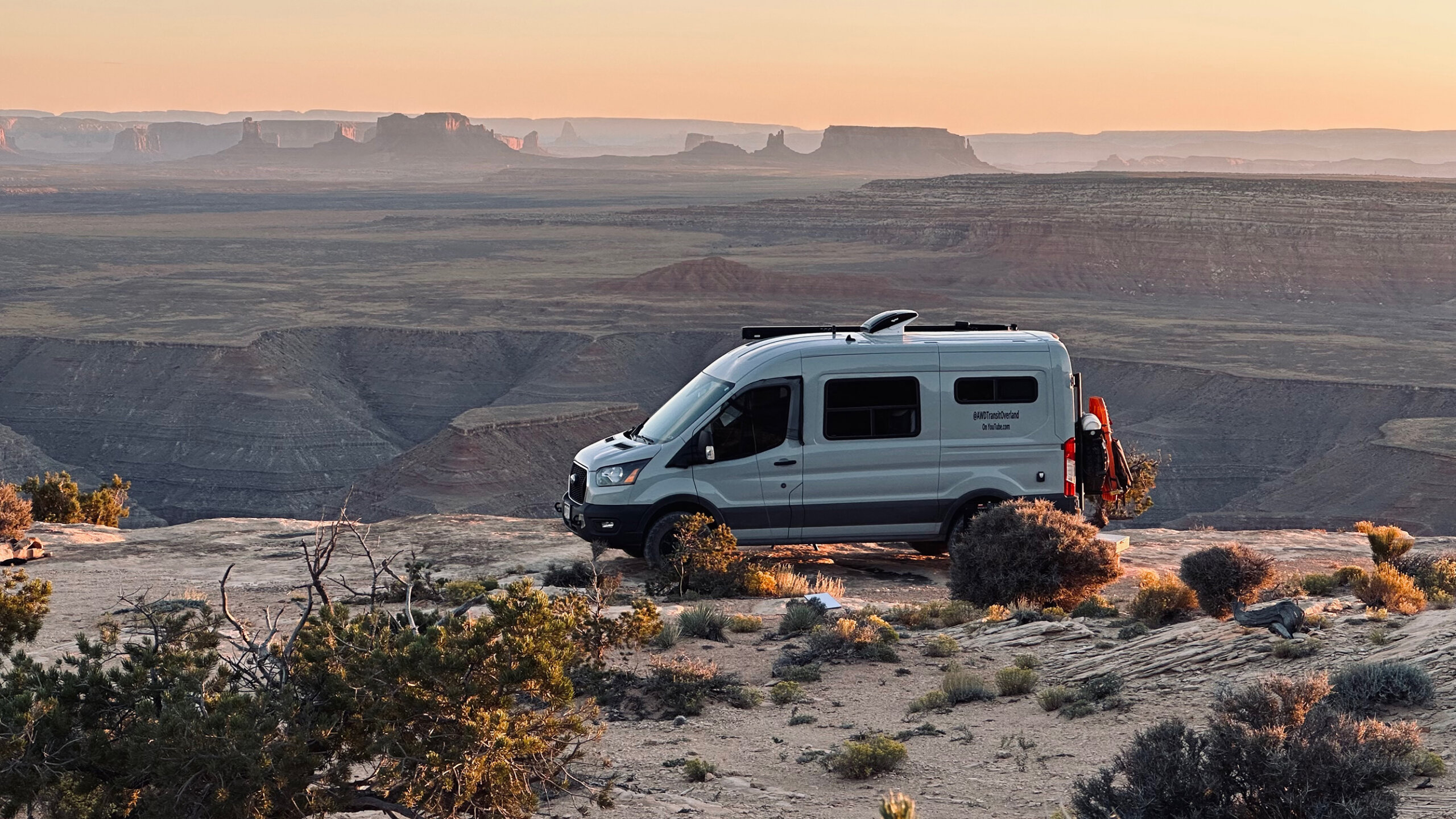
Jim Preston is often stopped by drivers of traditional four-wheel-drive vehicles who want to warn him about the trail ahead.
They see the size and profile of his Ford Transit and assume he has underestimated the terrain. Jim understands that most are trying to be helpful, but their advice usually reflects an assumption he has heard many times: a van does not belong where they are going.
He continues anyway.

Jim is not trying to prove that his AWD Transit Van can conquer every trail. He avoids boulder crawling, studies current trail conditions, and has no interest in forcing the vehicle through terrain better suited to a purpose-built rock crawler. What he does understand is how far a carefully prepared van can travel when the person behind the wheel knows how to read terrain, place a tire, and recognize the difference between a reasonable challenge and a poor decision.
That judgment has been developed over decades.
The Transit may be the vehicle viewers recognize from @AWDTransitOverland on Instagram and Youtube, but it is only the latest chapter in Jim’s long history of traveling through remote landscapes.
@AWDTransitOverland: An Experienced Hand in an Underestimated Van
Jim grew up around California’s mountains, historic mining towns, and wide-open scenery. He was drawn to the places hidden beyond the main road; remote communities, forgotten routes, old mining districts, and landscapes that required some effort to reach.

His off-road education began unusually early. At 12 years old, Jim was given access to the family’s 1957 Willys Jeep on a 2,000-acre mountain ranch in the Santa Cruz Mountains near San Jose. The ranch roads included steep rocky climbs, ruts, washouts, and off-camber fire trails that gave him plenty of opportunities to learn what a vehicle would do on uneven ground.
That experience was followed by years of travel throughout the West, including 16 years living in Alaska, journeys through the Yukon and Baja California, and international travel that occasionally placed him in situations far removed from ordinary tourism.

Long before he owned the Transit Van, Jim had already developed a practical relationship with vehicles. They were not status symbols or collections of accessories. They were transportation, shelter, and the means to reach places he wanted to understand.
For approximately 25 years, much of that travel happened in Ford Aerostars. Jim and his family used two of them for trips stretching from Baja to Alaska. Each had a full-size bed in the rear, storage beneath it, and eventually a roof-mounted cargo box. Jim also replaced the factory 14-inch wheels with 15-inch Ford Explorer wheels and stronger SUV tires to make them better suited to rough roads.
Both Aerostars accumulated roughly 300,000 miles before being retired. Their final departures were marked with what Jim calls decommissioning ceremonies, complete with vodka, gourmet appetizers prepared by his wife, and tears over the memories attached to each van.
That history helps explain the way he approached the Transit. He did not need the largest van, the tallest suspension, or the most elaborate interior. He needed the next vehicle to carry forward what had worked while improving the areas where the older vans had reached their limits.
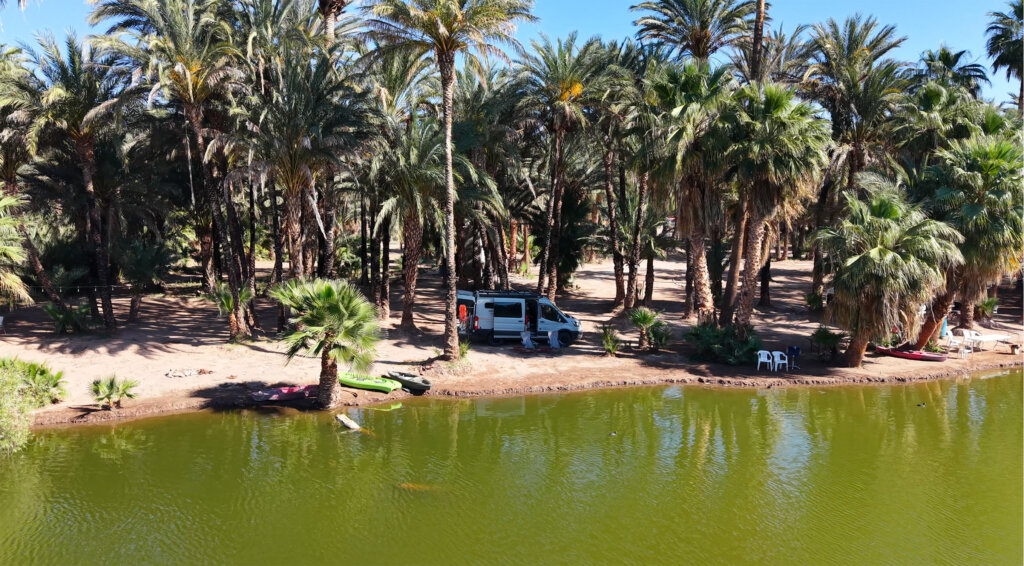
@AWDTransitOverland: Choosing the AWD Transit Van
When the final Aerostar was worn out in 2021, Jim began evaluating replacement platforms.
He researched Mercedes-Benz Sprinters but became concerned about ownership costs, maintenance complexity, and the design of the available all-wheel-drive system. The Ram ProMaster’s low rear axle and limited ground clearance did not fit the type of travel he had in mind. Chevrolet vans did not provide the standing room he wanted, and the remaining alternatives failed to offer the right balance of size, power, and capability.
That left the Ford Transit.
Jim ordered a 2022 AWD Transit Van with the 3.5-liter EcoBoost engine, a mid-height roof, and the short 130-inch wheelbase. The choices were deliberate rather than incidental.
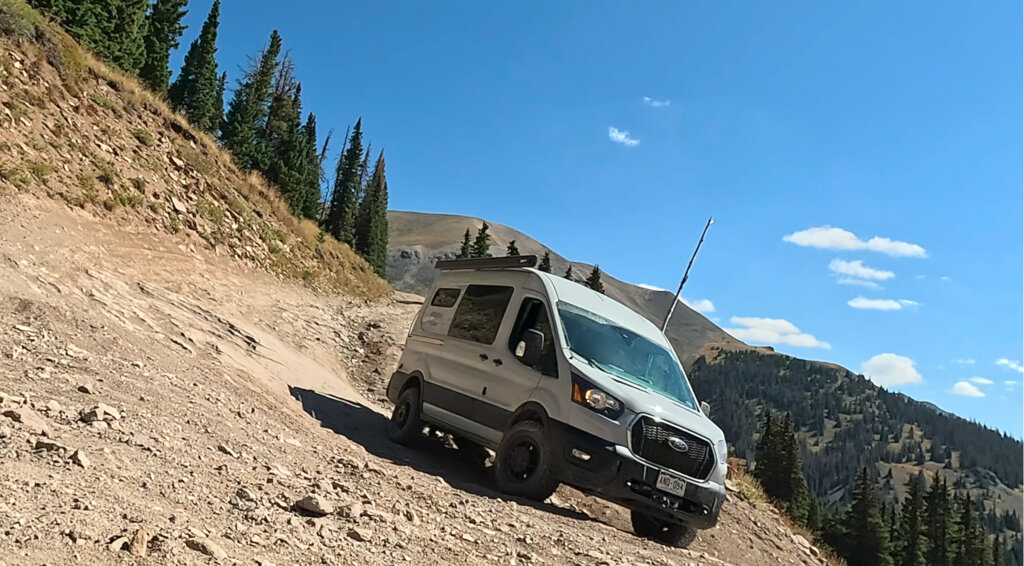
The EcoBoost provided strong power for mountain travel and high elevations. The mid-roof allowed Jim to stand inside without accepting the additional height and higher center of gravity of a taller van. The short wheelbase improved maneuverability on narrow trails, tight switchbacks, and technical terrain.
Despite its interior volume, the van’s wheelbase and overall length are shorter than those of a Jeep Gladiator. That compact footprint has become one of the reasons the Transit works so well for Jim’s style of travel.
Shortly after taking delivery in April 2022, he drove the van to Moab to learn what the AWD system could do. He found that the combination of the limited-slip differential and computer-managed power distribution provided more traction than he expected. The Transit climbed loose grades, rough ledges, and small boulders without the locking differentials he once assumed would be necessary.
Jim describes it simply: the van climbs like a goat.
That does not mean it performs exactly like a traditional four-wheel-drive vehicle. It means that, within the terrain Jim intends to travel, the AWD Transit Van provides enough capability without requiring him to accept the weight, complexity, or packaging compromises of something more extreme.

@AWDTransitOverland: Just Enough Van
The phrase “just enough” describes more than the Transit’s drivetrain.
It also defines the interior.
While waiting for the van to arrive, Jim watched a long list of camper conversion videos and visited an Adventure Van Expo looking for useful ideas. Most of the builds he saw were designed around pavement travel, developed campsites, or the comforts of a small motorhome.
They were not designed around the kind of body movement, vibration, steep terrain, and trail use Jim expected.
He wanted to keep the van light, maintain a low center of gravity, and avoid unnecessary fixed structures. He was also wary of using too many screws because repeated twisting and vibration can loosen conventional fasteners over time.
His solution was unconventional. Jim began prototyping the interior by attaching materials to the van with industrial Velcro. That experimentation eventually led to upholstered wall and ceiling panels insulated with 3M Thinsulate.
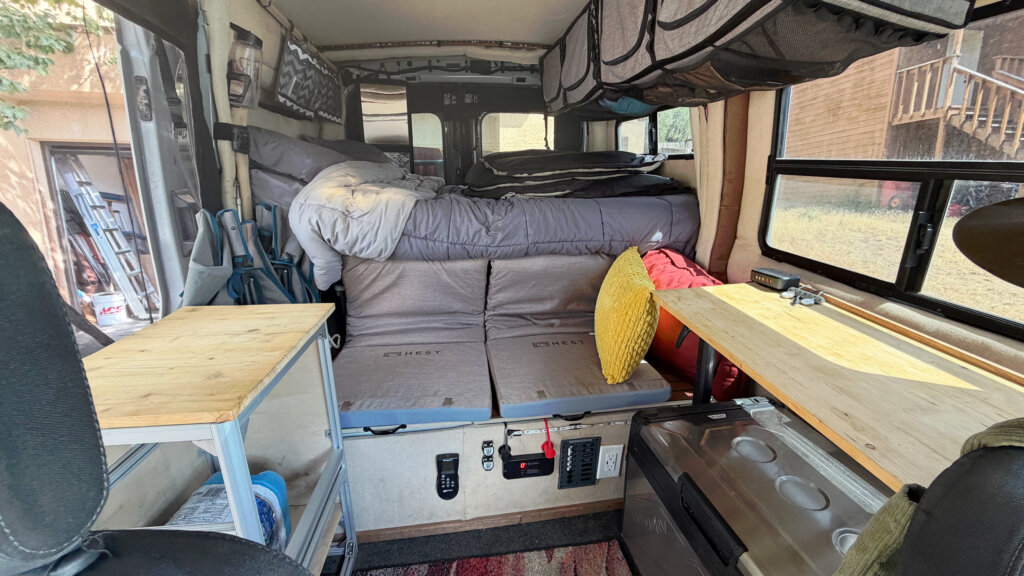
Jim and his partner, Katya, had to teach themselves how to make the panels. She helped glue the layers together and wrap the outer fabric, while the finished sections were secured to the van with Velcro. The mounting method allows the panels to move slightly as the body flexes on rough terrain rather than remaining rigidly fixed against it.
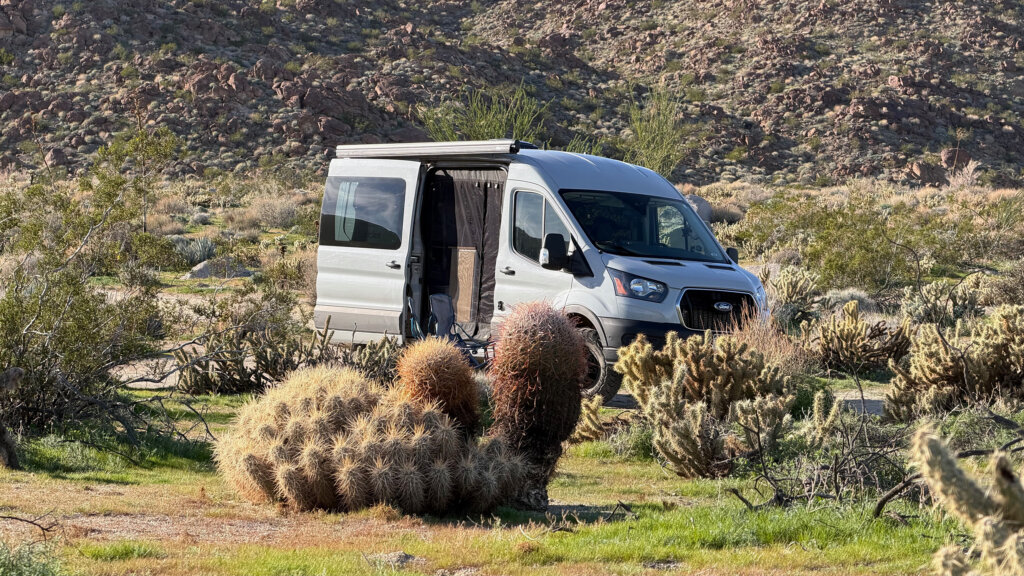
The rest of the interior follows a similar philosophy. Personal items, food, and kitchen equipment are stored in removable plastic bins beneath the bed. The van carries a portable toilet, shower equipment, cooking appliances, and an induction cooktop, but there is no permanent bathroom or fixed galley consuming limited space.
It is comfortable without becoming elaborate. The van has insulation, a propane heater, a refrigerator-freezer, solar charging, and a developed house electrical system, but it still functions as a compact and adaptable travel vehicle.
Jim spent decades camping in ground tents and sleeping bags. He appreciates the warmth and comfort of the Transit, especially in snow, wind, rain, and insects. He simply does not believe comfort requires turning the vehicle into something heavier or more complicated than the trip demands.
@AWDTransitOverland: A Build That Learned From the Trail
The Transit was not completed all at once. Its current configuration developed through experiences that exposed specific needs.
Early in the van’s life, a stock tire suffered a sidewall failure in Colorado’s remote Flat Tops region. The weather and location were favorable for changing it, but the process made Jim think about how much more difficult retrieving the factory spare could become in mud, snow, poor weather, or uneven terrain.
When he returned home to Grand Junction, he installed BFGoodrich all-terrain tires and began looking for a better spare-tire solution. That search led him to an Aluminess rear tire carrier.
The tire carrier solved a direct problem. It moved the spare from beneath the vehicle to a position where it could be reached quickly and without crawling under the van. After struggling with the factory spare-tire safety cable under good conditions, Jim saw immediate value in making the tire easier to access.
His positive experience with the carrier led to a second Aluminess purchase: a passenger-side rear-door rack for recovery equipment.
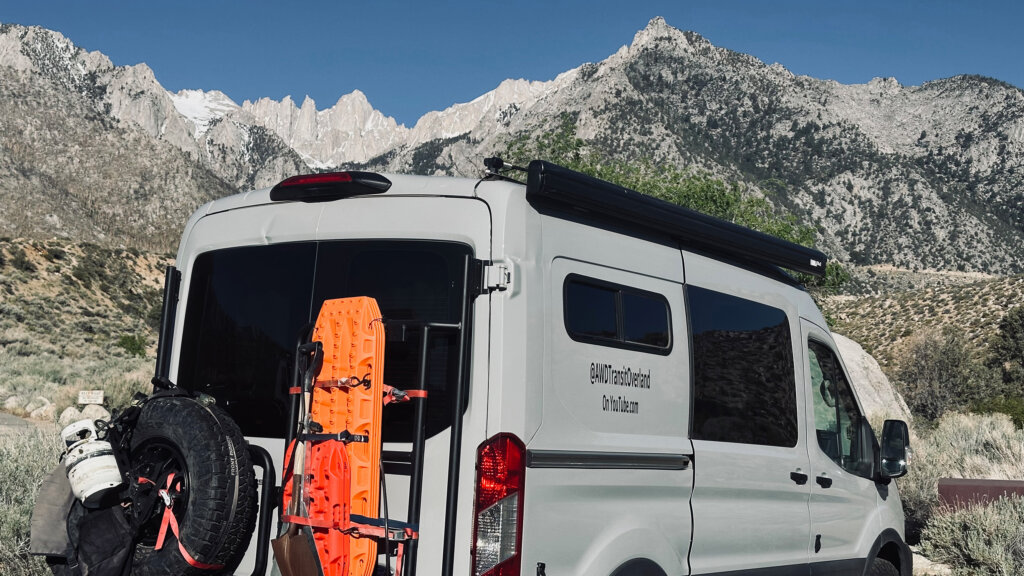
The rack now carries MaxTrax traction boards, a shovel, a Deadman winch anchor, and propane for an Ignik fireplace. The equipment remains outside the living space and can be reached without unpacking the van.
Another lesson came on a washed-out trail in Arizona’s Superstition Mountains. After working through a difficult section, Jim decided that the van should carry a winch.
He did not want a full replacement bumper. It would add weight, alter the exterior profile, and potentially reduce the approach angle he was trying to preserve. Instead, he selected an Aluminess hidden winch mount that positioned the recovery equipment behind the factory bumper.
The winch has not yet been used, but Jim does not consider that a reason to question the installation. Recovery equipment often earns its place by providing reassurance before it is ever needed. Knowing the van carries another option makes it easier to approach uncertain situations with a clear head.
The same pattern can be found throughout the build. A cooler was replaced by a 55-quart refrigerator-freezer, which led to a more capable Victron-based electrical system and solar charging. The suspension was upgraded as the van’s use became more demanding. Method Racing wheels and BFGoodrich KO3 tires added durability and confidence on rough surfaces.
Experience Is the Real Capability
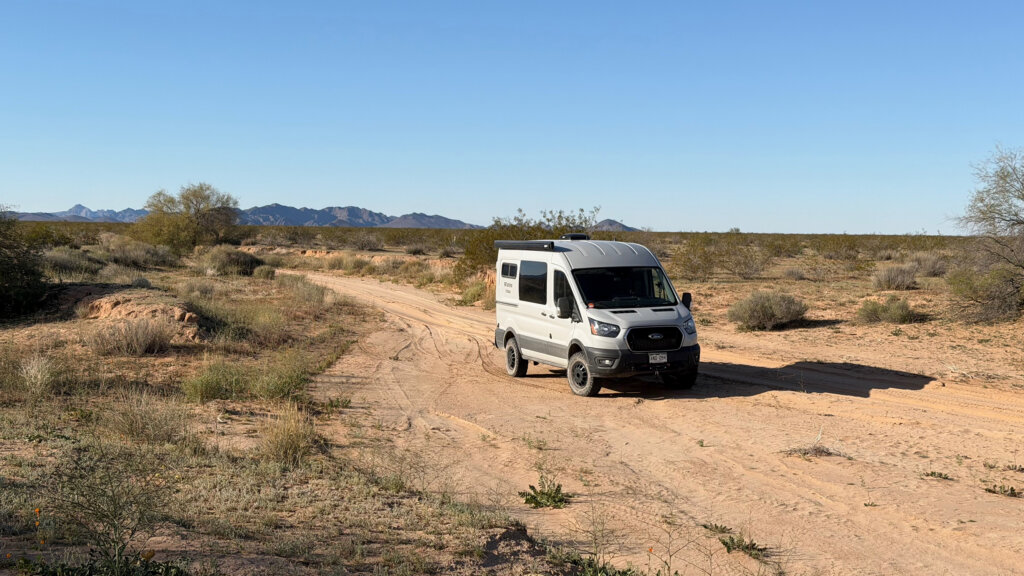
Jim believes preparation matters, but he does not confuse preparation with experience.
The Transit carries recovery boards, a shovel, an air compressor, tire repair equipment, a winch, and the hardware required to use those tools correctly. He stays current on maintenance and places particular importance on reliable tires because mechanical trouble in a remote area can quickly become more serious.
Those items matter, but they cannot choose a line through a washout or decide when the trail has deteriorated beyond a reasonable level.
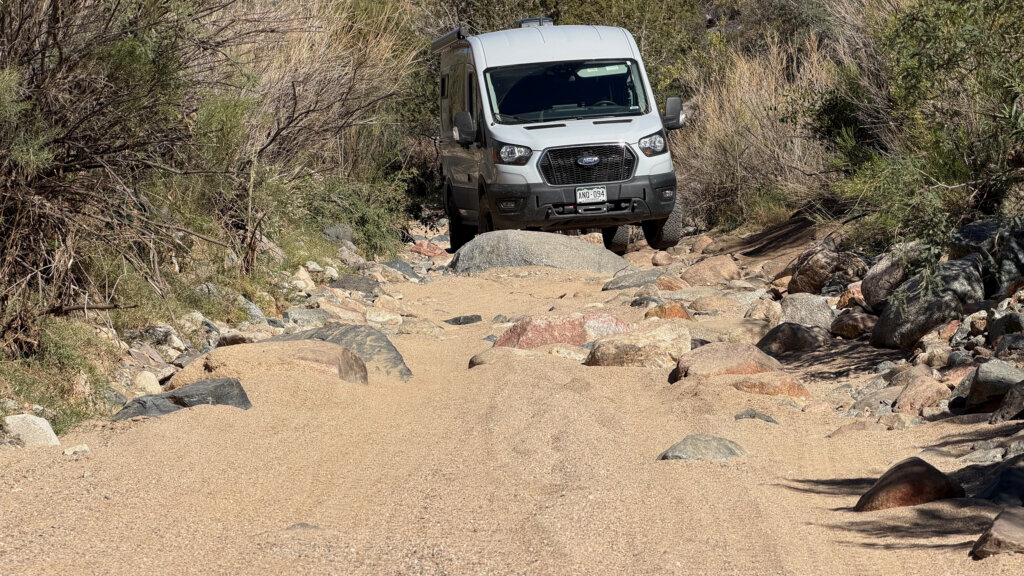
Jim’s understanding of tire placement began on the family ranch and developed through decades of off-road travel. Years spent mountain biking technical trails also helped sharpen his ability to read the ground ahead. On a bike, choosing the wrong line through rocks, ruts, or uneven terrain has immediate consequences. The same awareness transfers naturally to driving.
That experience is one reason Jim can take the Transit into places where drivers of more heavily modified vehicles assume it cannot go. Their rigs may have taller tires, more ground clearance, and more specialized equipment, but hardware does not automatically provide judgment.
Jim also understands restraint. After mountain biking part of the Rubicon Trail, he concluded that he had no interest in driving it. He does not seek out boulder fields or obstacles simply to demonstrate what the van can survive.
His advice to newer drivers is to use mapping resources, review recent trail reports, and increase difficulty gradually. Conditions can change quickly. A trail rated 2 out of 10 can become something much more serious after storms, erosion, or washouts.
The AWD Transit Van may be capable of a 4-out-of-10 trail in the hands of an experienced driver, but that does not mean a new owner should begin there.

Jim and Katya’s Version of Overland Travel
Although Jim sometimes travels alone to produce content for AWD Transit Overland, he prefers having Katya with him.
She helped construct the upholstered interior panels, manages the food and kitchen storage, and is comfortable assisting with trail repairs when rocks need to be stacked or a route requires problem-solving. She also drives technical sections herself and understands the importance of choosing a line and placing the tires correctly.
Jim describes her as brave, resilient, mechanically capable, and an exceptional cook.
Their shared travel style is not centered entirely on remote isolation. They enjoy boondocking, but they also prefer campgrounds because they like meeting other travelers. When passing through small towns, they seek out local restaurants and often sit at the bar so they can talk with people who live there.
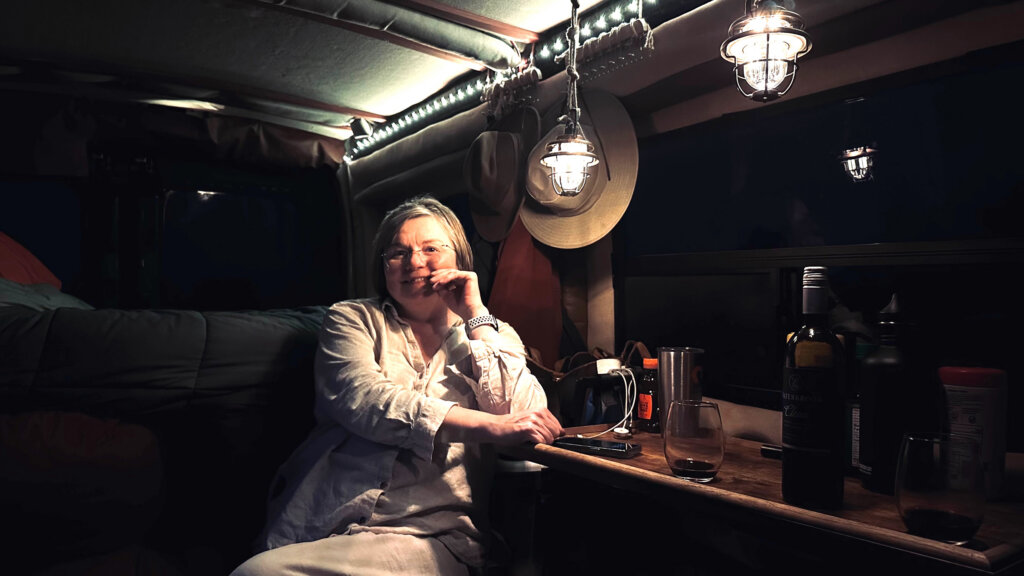
At camp, Katya’s meals are part of the experience. She once prepared an entire Thanksgiving dinner over a wood fire in Capitol Reef National Park, an accomplishment Jim still recalls with admiration.
Their evenings may involve a glass of wine, checking messages through a Starlink Mini, and planning the next day’s route. A pair of faux-pewter wine goblets purchased in Annapolis in 1997 has traveled with them through years of backpacking, camping, and vehicle-based travel.
That detail says as much about their philosophy as any piece of recovery equipment.
Adventure, for Jim and Katya, can include technical driving, remote scenery, historic mining towns, a good restaurant, a warm van, and wine at the end of the day. They do not see comfort and capability as opposing ideas.
The Transit gives them enough of both.

Back to the Sierra
After years spent exploring Alaska, the Yukon, Baja California, the Rocky Mountains, and other ranges around the world, Jim continues to feel a particularly strong connection to California’s Sierra Nevada.
He first camped there in 1953 at two years old and spent many summers around Lake Tahoe during the 1950s and 1960s. The region’s clear lakes, deep river pools, polished granite slabs, mountain scenery, and historic mining towns connect his present-day travels to the earliest years of his life.
One of his next planned journeys follows U.S. 395 through the eastern Sierra, combining familiar places with areas he has not yet visited. The route is expected to cover more than 700 miles and continue for roughly two weeks.

What makes the trip meaningful is not a difficult obstacle or another opportunity to prove the van’s capability. It is the chance to swim in clear mountain water, warm up on sun-heated granite, revisit old communities, and return to a landscape tied closely to his family history.
That may be the clearest expression of Jim Preston’s approach to overland travel.
The AWD Transit Van does not need to be everything. It only needs to be dependable, maneuverable, comfortable, and capable enough to carry him toward the places that still hold his curiosity.